
Part of Lawn, Irrigation, and Drainage
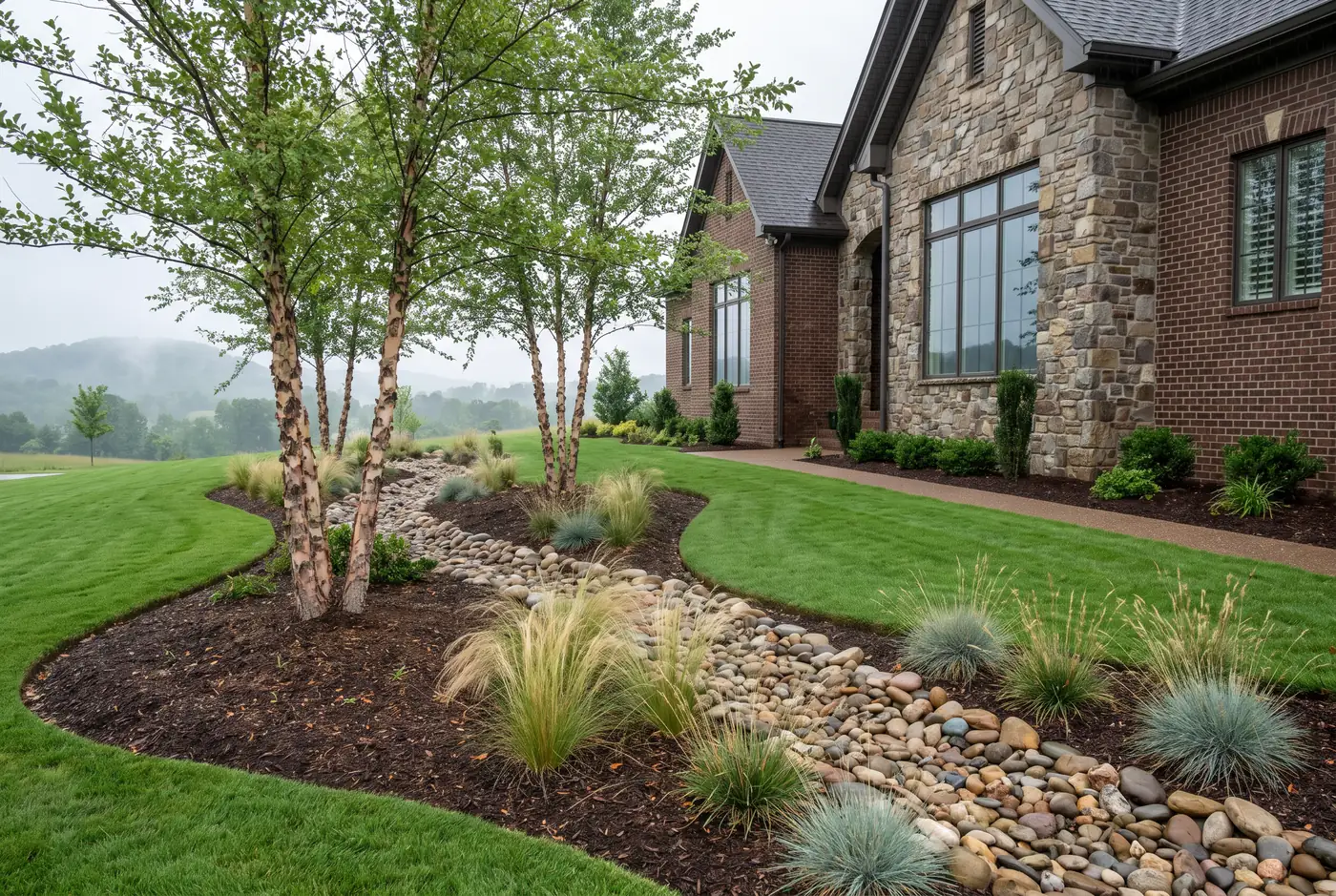
Water in the wrong place is the most common yard problem in Franklin. The clay under most lawns here holds water through the winter and spring, then hardens and cracks in late summer. On a sloped lot, rain from the neighbor uphill crosses your yard on its way down. On a flat lot, it sits. Add downspouts that empty at the corner of the house and beds edged tight against the foundation, and you get the symptoms homeowners call about: a lawn that squishes for days, a patio that holds puddles, mosquitoes in June, and water pushing toward the crawl space.
Good drainage starts with finding where the water comes from, not just where it ends up. We walk the property, ideally during or soon after a rain, and trace every source: roof, driveway, neighboring lots, and springs or seeps that show up in limestone country. Then we design a system that collects it, carries it, and releases it somewhere safe. Most of the time that is a combination of grading, buried pipe, and a surface feature that looks like it belongs in the landscape.
French drains are the workhorse for soggy strips and the base of slopes. Because clay drains slowly, we size the trench and gravel to hold water long enough for the pipe to carry it off, and we wrap the stone in fabric so fine clay does not silt it shut.
Catch basins and solid pipe handle the concentrated water: a low corner, the end of a driveway, a patio with nowhere to shed. Roof water belongs in solid pipe, not perforated, so it reaches the outlet instead of soaking back into the soil near the house.
Dry creek beds turn a necessary runoff path into part of the design. Lined with river rock and edged with Tennessee fieldstone, planted with little bluestem, muhly grass, and native perennials along the banks, they carry storm water in the spring and read as a landscape feature the rest of the year. On lots near the Harpeth River or creeks, we pay close attention to floodplain rules and what can be built in low areas.
We give you a fixed written price after the design consultation, tied to the scaled plan you approve. If you ask for a change along the way, we price it in writing before we do it.
If you are tired of waiting for the yard to dry out, the first step is a walk of the property after a rain. We will show you where the water is coming from and what it takes to fix it. Book a design consultation or call (615) 703-6725.
Usually because of the clay. Middle Tennessee soil drains slowly, and in a low spot or on a flat lot water has nowhere to go but down, which takes days. Compacted soil from construction makes it worse. The fix depends on the source: regrading for a low area, a French drain or catch basin where water collects, or tying downspouts into buried lines so roof water stops landing on the lawn.
A French drain is a trench with gravel and perforated pipe that collects water along its length, which suits soggy strips and the base of slopes. A catch basin is a box set at a single low point with a grate on top that collects surface water and sends it into solid pipe. Many Franklin yards need both, with basins at the low points feeding a line that carries water away.
It has to discharge somewhere safe: a lower part of your lot, a pop up emitter in the lawn, a dry creek bed, or the street or storm system where the city or county allows it. You cannot direct it onto a neighbor's property. In HOA neighborhoods and near Harpeth River floodplain areas there can be extra rules, and we confirm them for your lot before we design the outlet.
Often, yes, if the problem is surface water. Downspouts that dump at the corner of the house, soil that slopes toward the foundation, and beds that trap water against the wall are the common causes, and they are landscape fixes. If water is already coming through the foundation or the crawl space stays wet after the yard is corrected, we will tell you to bring in a waterproofing specialist.
Zoned sprinklers, drip lines for beds, and smart controllers designed around Franklin clay, slopes, and the way your yard gets sun.
Learn morePlanting, trees, renovations, and bed work for Franklin homes, built from a scaled plan you approve and a fixed written price.
Learn moreCall (615) 703-6725 or request your free quote online. We serve Franklin and Williamson County.